


In this annual event of the injection mold industry, Yuanfang Technology made a wonderful appearance with its precision plastic products and demonstrating the independent innovation capabilities and achievements of Chinese mold making companies. During the exhibition, the person in charge of Yuanfang’s business department learned in detail about the new technologies and equipment in the mold industry displayed at the exhibition.
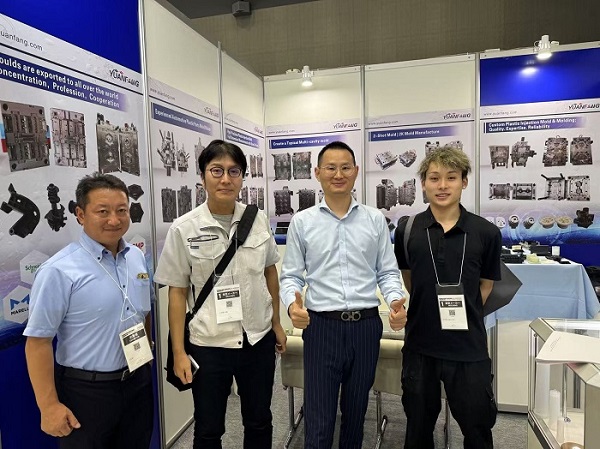
We made every effort to introduce Yuanfang Technology’s advantages in injection molds to customers, seeking new breakthroughs and new developments for Yuanfang molds.
Exhibition Introduction
Name: 2024 Japan International Mold Exhibition INTERMOLD
Exhibition date: June 26, 2024 – June 28, 2024
Exhibition location: Nagoya, Japan
Exhibition cycle: Twice a year, each held in a different city
Organizer: Japan Die & Mold Industry Association
As an exhibition showcasing the most advanced mold technology in Japan, INTERMOLD is hosted by the Japan Mold Industry Association and is strongly supported by the Ministry of Economy, Trade and Industry, the Ministry of Foreign Affairs, the city government, the Chamber of Commerce, the Japan External Trade Organization and other institutions. The exhibition is held twice a year in Tokyo, Osaka, Nagoya and other cities. Every year, industry professionals from Japan and around the world come to the exhibition to visit and purchase.
Exhibits range
1. Stamping dies, plastic molds, die-casting dies, forging dies, and mold standard parts required for automobiles, motorcycles, electronic information, and home appliances; mold processing equipment, measuring equipment, mold rapid prototyping equipment, mold materials, mold CAD/CAE/CAM software, etc.
2. Machine tools: ordinary lathes, CNC lathes, boring machines, drilling machines, boring machines, milling machines, grinders, sawing machines, slotting machines, planers, EDM wire cutting machines, EDM (discharge) forming machines, injection molding machines, metal cutting and forming machine tools, welding and gas cutting machine tools, etc.
3. Tools: measuring tools, forming tools, knives, grinding tools, molds and accessories, tooling fixtures, etc.
4. Machine tool accessories and parts: hydraulic parts, pneumatic parts, machine tool electrical and electronic equipment, control and drive systems, lubricants and coolants, waste treatment equipment, etc.
5. 3D printing and additive manufacturing: industrial 3D printers, rapid prototyping, 3D scanners, 3D printing services, etc.
6. Others: flexible processing, installation technology, operation technology, automation equipment, industrial robots, welding equipment, heat treatment equipment, precision instruments, laser and water jet cutting equipment, etc.
Japanese molds are generally divided into eight categories: stamping molds, forging molds, casting molds, die-casting molds, plastic molds, glass molds, rubber molds and powder metallurgy molds. According to the statistics of the production amount of various molds in Japan, stamping molds and plastic molds are the main ones, and the two together account for about 80% of the total production amount. The main application markets are automobile bodies or electrical and electronic parts, and mobile phones and automobile interior structures such as instrument settings and switchboards.
Other product structures such as die-casting molds account for about 7% and forging molds account for about 4%, which are very similar to the production structure of mold types in my country. In terms of production amount, except for casting molds, other types of molds grew slightly in 2004 compared with the previous year. Among them, stamping molds grew the most, reaching 11.2%, and die-casting molds and plastic molds ranked second and third in growth rate, at 6.4% and 5.6% respectively.
Import and export analysis Japan has always been a major exporter of molds. In 2004, it was still the world’s largest mold exporter. The mold export value in that year reached 360 billion yen, which was about 6.1 times the import value of 59.9 billion yen.
In fact, Japan’s export value was about 10 times the import value before 1996, and the gap was as high as 16 times in the early 1990s. However, in recent years, due to the bubble of Japan’s economy, coupled with the relative improvement of mold technology in Asian countries, manufacturing and labor costs are relatively cheaper than Japan, so the focus of mold manufacturing has gradually shifted to other overseas countries, resulting in a continuous increase in imports in recent years, while the gap between imports and exports has been narrowing year by year.
 Polish
 English
 German
 Spanish
 French
 Italian
 Portuguese
 Japanese
 Arabic
 Korean
 Russian
 Chinese